Enterprise AI
Rillet Becomes $1 Billion Unicorn After $100 Million AI Accounting Raise
The two-year-old enterprise software company is betting that the future of accounting will be built around real-time ledgers and specialized AI agents rather than AI features layered onto decades-old ERP architecture.
AI-native accounting startup Rillet has joined the unicorn club after raising $100 million in a Series C funding round at a $1 billion valuation, highlighting investor enthusiasm for artificial intelligence systems designed to replace or rethink core enterprise software.
The round was led by ICONIQ and included participation from existing investors Sequoia Capital and Andreessen Horowitz, alongside Sequoia Global Equities, Bain Capital Ventures, Oak HC/FT, Battery Ventures, FirstMark, Scale Venture Partners and Creandum.
Rillet says the financing represents its third funding round in roughly the past year and pushes the company's total funding above $200 million.
The milestone is notable not only because of the valuation, but because of the speed at which the company has scaled. Rillet emerged publicly roughly two years ago and is now positioning itself against some of the most deeply entrenched names in enterprise finance software.
A $100 Million Round at a $1 Billion Valuation
Rillet announced the Series C in August 2026, saying ICONIQ led the investment at a $1 billion valuation. ICONIQ General Partner Seth Pierrepont is also joining Rillet's board.
According to Rillet, new annual recurring revenue doubled over the three months preceding the funding announcement, while its customer base surpassed 600 organizations.
Fortune separately reported that the two-year-old startup had reached the $1 billion valuation following the new financing, making it one of the latest enterprise AI companies to attain unicorn status.
Rillet co-founder and CEO Nicolas Kopp has also said the financing came together in less than 48 hours, illustrating the intensity of investor demand surrounding fast-growing infrastructure companies at the intersection of enterprise software, accounting and AI.
That claim describes the fundraising process as characterized by the company and its leadership; it should not be interpreted as meaning the entire legal, diligence and settlement process for the transaction was completed within 48 hours.
Why Investors Are Looking at AI-Native ERP
Enterprise resource planning software sits at the heart of large organizations. ERP platforms manage financial records, procurement, revenue, reporting, consolidation and other critical business processes.
For decades, the category has been dominated by companies such as SAP, Oracle, Microsoft, Workday and NetSuite. Many of these systems were designed long before generative AI and autonomous software agents became practical.
That architecture has created an opening for a new generation of companies that are not simply adding an AI assistant to existing accounting software, but are designing the underlying finance system around AI from the beginning.
Rillet is one of the startups pursuing that strategy.
AI Agents Inside the General Ledger
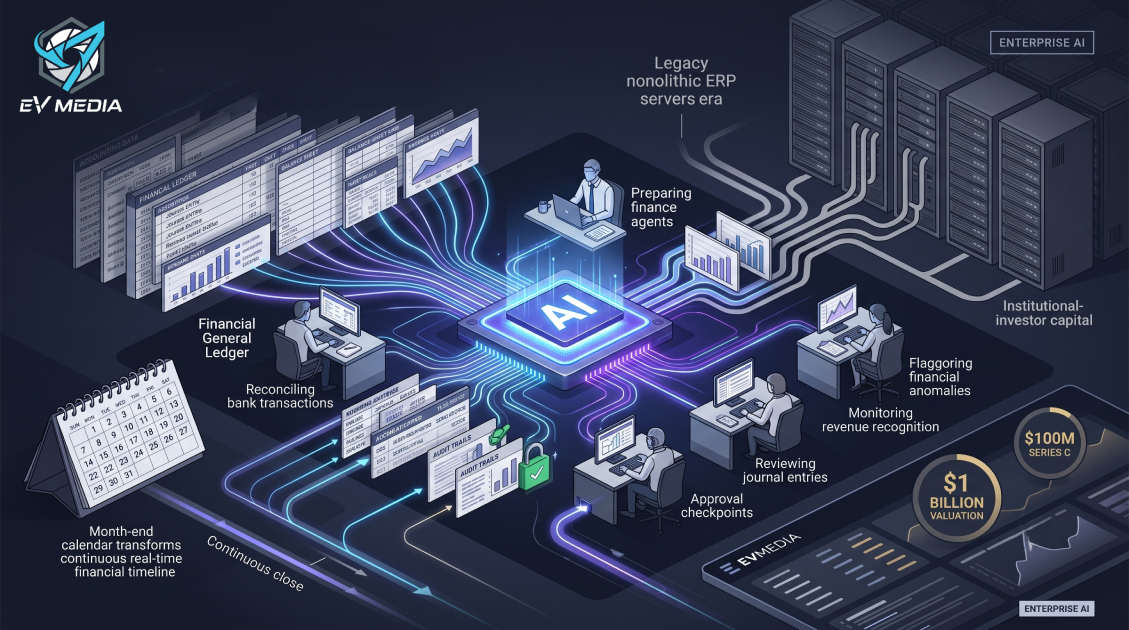
Rillet's central product argument is architectural. Instead of treating AI as a chat interface sitting on top of accounting data, the company embeds specialized agents directly into finance workflows connected to the general ledger.
Its Aura AI system includes agents designed for accounting processes such as accruals, journal entries, cash reconciliation, variance analysis and other close-related tasks.
Rillet describes these agents as operating under a propose-and-approve model. The software can investigate financial information, identify an issue, prepare accounting work and present it for review, while a human controller retains approval authority before sensitive actions are finalized.
This approach is materially different from an accounting chatbot that only responds to questions. An agent connected to current ledger information can, in theory, continuously monitor financial activity, detect exceptions, draft entries and prepare reconciliations without waiting for a user to manually initiate every step.
The Push Toward a Continuous Close
One of Rillet's major product concepts is what it calls a continuous close. Traditional accounting teams often spend the end of each month reconciling transactions, booking accruals, validating balances and preparing financial statements in a concentrated closing process.
Rillet's model attempts to move much of that work into the month itself. Financial data is ingested and validated continuously, while reconciliations, anomaly detection and accounting controls can operate throughout the reporting period.
The goal is to keep the general ledger substantially closer to a close-ready state every day instead of allowing large volumes of accounting work to accumulate until month-end.
In that model, AI is not merely generating summaries. It becomes part of the operating infrastructure through which finance work is performed.
600-Plus Customers and Expansion Beyond Technology
Rillet says it now serves more than 600 customers, ranging from fast-growing technology companies to larger enterprises.
Fortune reported that customers cited by the company include businesses such as Neuralink, Skild AI and Mercor, while Rillet says a growing proportion of its customer base now comes from industries outside technology and artificial intelligence.
The company is targeting sectors including healthcare, biotechnology, fintech, logistics and professional services as it attempts to demonstrate that its architecture can work beyond venture-backed technology startups.
Rillet has also publicly positioned its software as an alternative for organizations considering replacements for established systems such as Oracle Fusion, SAP, Workday, Microsoft Great Plains and NetSuite.
Those replacement claims are part of Rillet's own market positioning and do not by themselves establish that the company has displaced legacy ERP providers at significant industry-wide scale.
EY Alliance Adds Enterprise Credibility
Rillet has also been building relationships with the accounting and consulting industry as it targets larger enterprises.
In April 2026, Ernst & Young LLP and Rillet announced an alliance focused on AI-native finance transformation.
The collaboration combines EY's finance transformation, technology consulting, risk, controls and operating-model expertise with Rillet's general-ledger-first platform.
According to EY, the alliance is intended to help organizations modernize finance operations while embedding risk management and controls into the transformation rather than treating them as a separate implementation layer.
That relationship matters in enterprise accounting because replacing a core financial platform involves far more than software features. Large organizations must also consider internal controls, audit readiness, permissions, regulatory requirements, migration risk and the integrity of historical financial data.
Why This Is Different From the First Enterprise AI Wave
Much of the first enterprise generative AI boom focused on copilots: interfaces that helped employees write text, search documents, summarize information or ask questions about company data.
Rillet represents a more ambitious phase of the market in which AI agents are being placed inside transactional systems of record.
Accounting is an especially demanding test case. Financial systems require determinism, authorization controls, traceability, audit trails and accurate handling of policies that cannot simply be replaced with probabilistic model outputs.
The challenge for AI-native ERP companies is therefore to combine the flexibility of AI with the controls expected from financial infrastructure.
Rillet says its platform attempts to solve that problem by allowing agents to operate with live accounting context while preserving human approval and a record of the actions taken.
Can AI Really Challenge SAP, Oracle and NetSuite?
A $1 billion valuation does not mean the established ERP market has already been disrupted. Incumbents have enormous customer bases, mature implementation ecosystems, global compliance capabilities and decades of accumulated enterprise functionality.
Replacing an ERP system can also be one of the most complex technology projects an organization undertakes. Financial systems are deeply connected to billing, payroll, banks, tax platforms, customer relationship systems, procurement, analytics and regulatory reporting.
The opportunity for startups such as Rillet is that legacy scale can also become an architectural constraint. New platforms can be built around real-time data, APIs, cloud infrastructure and AI agents without preserving decades of earlier software assumptions.
The coming competition may therefore be less about whether traditional ERP disappears and more about whether AI-native challengers can capture organizations that no longer want to operate finance through batch processes, spreadsheets and separately attached automation tools.
What the $1 Billion Valuation Signals
Rillet's new valuation is another sign that investors increasingly view application-layer enterprise AI as a major market rather than merely an extension of foundation models.
The largest economic opportunity may ultimately belong to companies that use AI to redesign expensive, repetitive business workflows rather than simply provide access to a general-purpose chatbot.
Accounting is particularly attractive because finance teams operate on structured information, repeatable processes and clearly defined controls, making portions of the workflow suitable for automation while still requiring expert human judgment.
If agentic systems can reliably perform more of that operational work, organizations could potentially run finance teams differently: with humans concentrating on judgment, planning, controls and business strategy while software handles an increasing share of repetitive execution.
The Risks Still Matter
Moving AI agents deeper into accounting systems creates new risks alongside potential productivity gains.
Enterprises need to know which agent performed an action, what information it relied upon, which accounting policy it applied, who approved the result, and whether changes can be reconstructed during an audit.
Security and permissions are equally important. An autonomous system with access to a general ledger or connected financial systems must operate under tightly defined privileges and approval boundaries.
Model errors also cannot simply be treated as ordinary chatbot mistakes when the output affects journal entries, revenue recognition, reconciliations or official financial reporting.
The success of AI-native ERP will therefore depend as much on governance, controls and auditability as on the intelligence of the underlying AI models.
Key Takeaway
Rillet's $100 million Series C and $1 billion valuation are significant because they represent more than another large AI funding round.
They reflect a larger shift in enterprise software: AI is moving from an assistant that sits beside business systems toward an operating layer capable of participating directly in core workflows.
Rillet is betting that accounting will become continuous, agentic and increasingly automated, while finance professionals retain control over judgment and approval.
Whether that model can challenge ERP giants at global scale remains an open question. But with more than $200 million raised, a reported base of over 600 customers and backing from some of technology's most influential investors, Rillet now has significant capital to test that thesis.
Sources: Rillet, Fortune, TechCrunch reporting distributed through Yahoo Finance, EY and related company disclosures.