Technology Briefing
Anthropic Settlement, Google AI Chip and Garmin Cirqa Lead Tech News
Copyright law, specialized AI infrastructure, screenless health tracking and rebuilt consumer platforms are shaping the latest technology cycle.
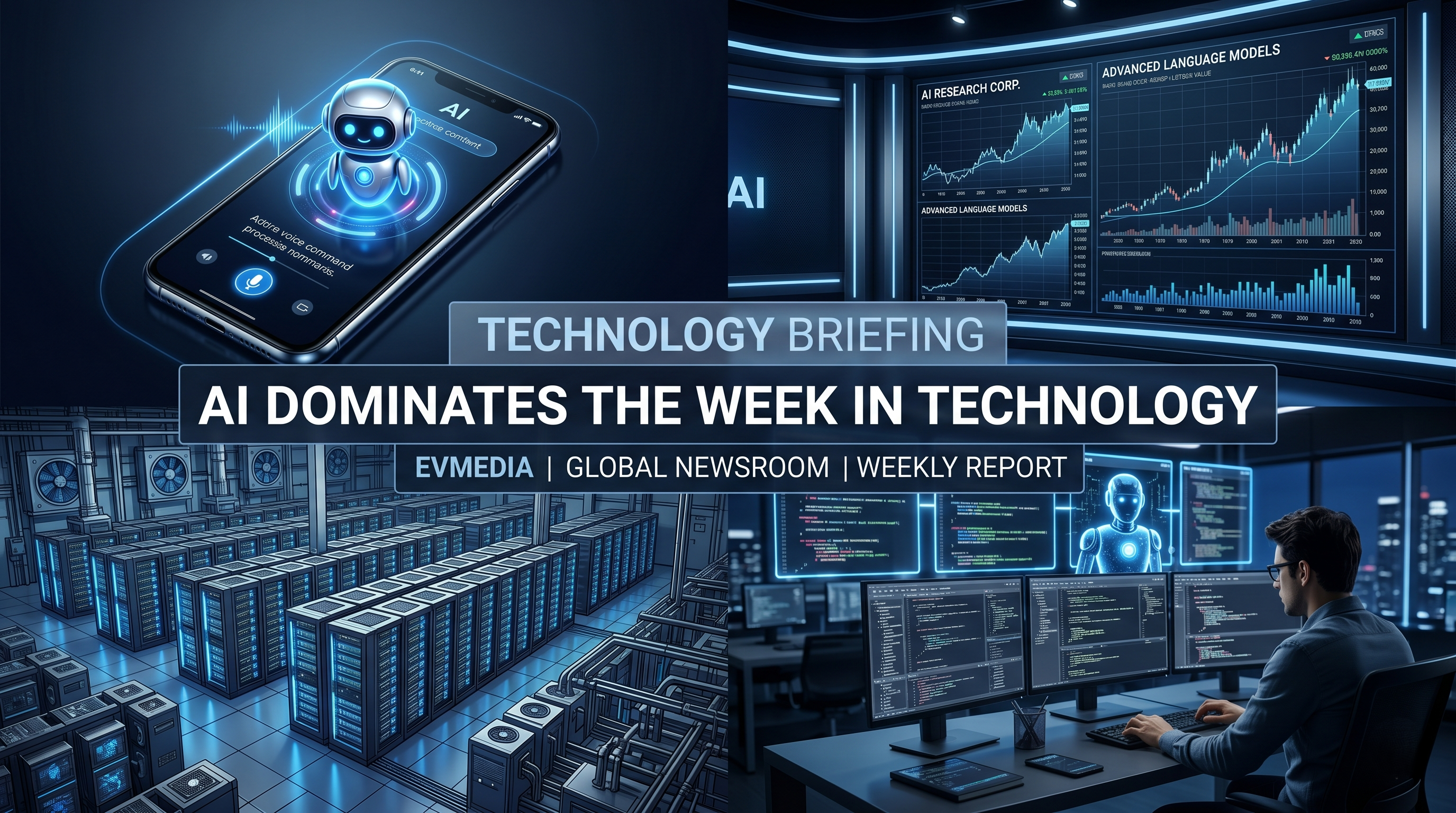
The latest technology headlines show the industry advancing on several interconnected fronts. Anthropic has secured final court approval for a historic copyright settlement, Google is reportedly developing specialized hardware for future Gemini workloads, Garmin has entered the screenless fitness-tracker market, and major social and gaming platforms are changing how users interact with their services.
The common theme is technological scale. Artificial-intelligence companies are confronting the legal consequences of how training data was acquired, cloud providers are looking for more efficient computing architectures, wearable companies are competing on continuous health data, and consumer platforms are rebuilding products around reliability, flexibility and subscription value.
Judge Approves Anthropic's $1.5 Billion Copyright Settlement
A federal judge in San Francisco has granted final approval to Anthropic's $1.5 billion settlement with authors and publishers who alleged that the company used unlawfully obtained books while developing its Claude artificial intelligence models.
The class-action case was brought by authors including Andrea Bartz, Charles Graeber and Kirk Wallace Johnson. It concerned hundreds of thousands of books allegedly downloaded from online piracy repositories and retained in a central digital library used by Anthropic.
The settlement covers approximately 482,000 eligible works and is expected to provide roughly $3,000 for each covered book. Reports indicate that more than 91 percent of the affected works had already been claimed by eligible authors or publishers by the time of final approval.
The case is especially important because the court separated two legal questions that are often combined in debates about generative AI. An earlier ruling found that using copyrighted books to train an AI system could qualify as fair use, but it did not protect the acquisition or storage of copies obtained through piracy.
In practical terms, the outcome does not establish that every instance of AI training on copyrighted material is unlawful. Instead, it warns AI companies that even a potentially lawful training purpose does not excuse obtaining source material through illegal channels.
Why the Anthropic Case Could Reshape AI Data Practices
The settlement has been described as the largest known copyright recovery in the United States. Its scale may encourage AI laboratories, investors and enterprise customers to examine the origin and licensing status of training datasets more closely.
Frontier-model developers have assembled enormous datasets from books, websites, code repositories and other digital sources. The Anthropic case increases the financial risk associated with datasets whose provenance cannot be documented.
Future AI development may therefore rely more heavily on licensed archives, publisher agreements, synthetic information, public-domain works and datasets carrying verifiable usage permissions.
The settlement does not resolve every dispute concerning generative AI and copyright. Other authors, publishers, news organizations, artists and rights holders continue to pursue separate cases against AI companies.
Google Reportedly Develops the Frozen v2 AI Chip
Google is reportedly developing a specialized AI server chip internally known as Frozen v2. The project has not been publicly announced by Google, and its specifications, release schedule and final commercial name remain unconfirmed.
Reports indicate that Frozen v2 is being designed to run future Gemini models more efficiently by bringing model-specific capabilities closer to the silicon. One reported objective is to reduce pressure on expensive high-bandwidth memory and lower the infrastructure required for large-scale AI inference.
The project is reportedly targeting a possible 2028 introduction. Because the chip remains under development, its architecture and timing may change before deployment.
Google already operates a mature Tensor Processing Unit ecosystem. A more specialized Gemini-focused accelerator could take the strategy further by optimizing hardware around particular model architectures rather than relying only on general-purpose AI accelerators.
Such a design could improve efficiency but may also reduce flexibility. Hardware closely tied to one model generation risks becoming less useful when AI architectures change. The success of Frozen v2 would therefore depend on Google's ability to predict how Gemini will evolve several years in advance.
Garmin Launches the Screenless CIRQA Smart Band
Garmin has officially introduced the CIRQA Smart Band, its first screenless health and fitness tracker. Priced at $199.99 in the United States, the band is positioned as a subscription-free alternative to screenless products such as Whoop.
CIRQA is designed for continuous monitoring without notifications or an always-visible display. Garmin says the device can track heart rate, blood oxygen, skin temperature, stress, sleep, breathing and movement while delivering up to 10 days of battery life.
Users view their information through the Garmin Connect application. The band can track more than 80 activities, with a selection of activities detected automatically. A physical shortcut button can also start a preferred workout without requiring a screen.
Garmin's main competitive advantage is its lack of a mandatory recurring subscription. Customers purchase the hardware once and receive access to Garmin Connect health and activity information without an additional monthly membership.
The launch reflects growing demand for wearable devices that gather health information quietly. Some consumers want recovery and sleep insights but do not want another display competing for their attention.
X Rebuilds Its Android Application
X has begun rolling out a completely rebuilt Android application. The company says the app was reconstructed from the ground up to provide faster, smoother and more reliable performance.
The rebuild is also intended to give X a stronger technical foundation for releasing future features. Replacing an established application rather than incrementally updating it is a substantial engineering undertaking because developers must preserve existing functionality while changing the underlying architecture.
The real test will be how the application performs across the fragmented Android ecosystem, which includes devices with widely different processors, memory capacities, display sizes and operating-system versions.
Instagram Lets Users Replace Music on Existing Posts
Instagram has expanded post-editing controls by allowing users to replace audio attached to content that has already been published. Users can open a post's editing controls, select its audio option and choose a new track without deleting and uploading the post again.
The feature is particularly useful when a song becomes unavailable, when licensing conditions change or when a creator wants to update older content with more relevant audio while preserving its likes, comments and shares.
It also reflects Instagram's continued effort to make existing posts more flexible rather than treating publication as a permanently fixed action.
Meta Horizon+ Adds an Xbox Game Pass Starter Edition
Meta and Microsoft have expanded their gaming partnership by adding a starter edition of Xbox Game Pass to qualifying Meta Horizon+ subscriptions.
Meta says the new benefit includes access to more than 50 Xbox games through supported Quest headsets, in addition to the library of more than 100 virtual-reality titles already included with Horizon+.
The bundle strengthens Meta Quest's position as a general entertainment device rather than a platform limited to native virtual-reality games. It also gives Microsoft another distribution channel for Xbox Cloud Gaming without requiring users to purchase a traditional Xbox console.
Availability remains subject to supported regions, devices, internet connectivity and Microsoft's cloud-gaming requirements.
United States Warns Chinese AI Developers About Potential Sanctions
United States Treasury Secretary Scott Bessent has warned that Chinese AI companies could face sanctions if the government establishes that their models were built through the unauthorized extraction of American intellectual property.
The warning concerns techniques commonly described as model distillation, in which outputs from a more capable system are used to help train or refine another model. Distillation is not automatically illegal, but companies may violate terms of service or intellectual-property protections depending on how data and model outputs are obtained and used.
No broad sanctions against Chinese AI models were announced alongside the warning. The administration's position is therefore best understood as a threat of possible enforcement, subject to evidence and future policy decisions.
The development forms part of a wider U.S.-China dispute over advanced models, semiconductor access, training data, national security and the international distribution of open-weight AI systems.
What These Developments Reveal
Anthropic's settlement shows that data provenance can become a billion-dollar liability. Google's reported chip project demonstrates the pressure to make AI inference less expensive. Garmin's CIRQA launch shows that consumers may value passive health intelligence over another screen.
X and Instagram are trying to reduce friction in mature social applications, while Meta and Microsoft are combining subscriptions to increase the value of their hardware and cloud-gaming ecosystems.
At the policy level, Washington's warning to Chinese AI developers shows that model training methods and intellectual-property disputes are becoming part of international economic strategy.
Key Takeaway
Today's technology cycle is not being driven by a single breakthrough. Instead, it reflects an industry trying to make artificial intelligence legally defensible, computationally efficient, commercially sustainable and deeply integrated into consumer products.
The companies that succeed will need more than capable models or attractive devices. They will need traceable datasets, efficient infrastructure, dependable software and business models that users can justify over the long term.
Sources: Reuters, Associated Press, The Verge, Garmin, X, Instagram Help Center, Meta, TechCrunch, The Information reporting cited by technology publications, and related industry coverage.