Breaking Technology News
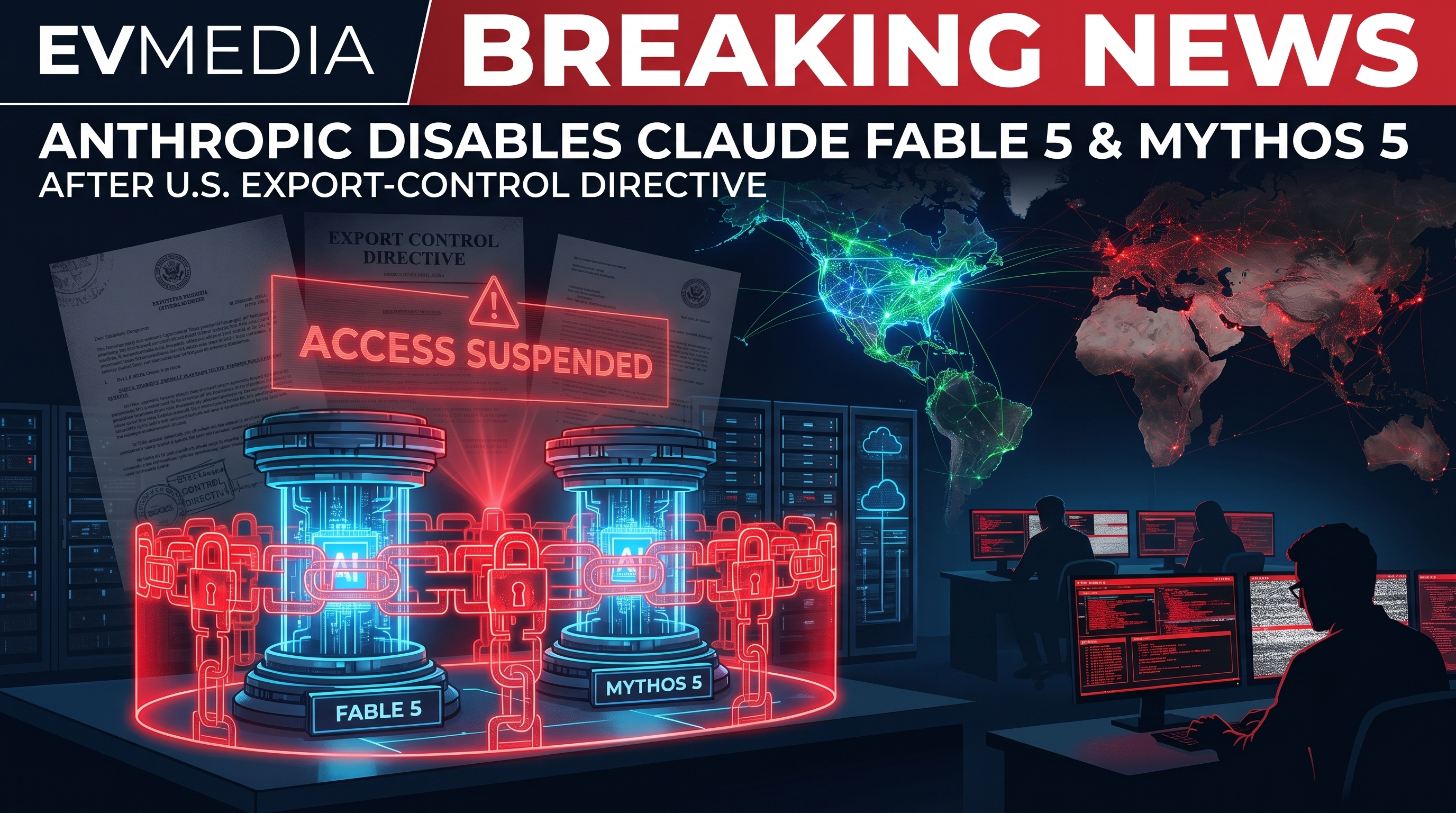
Anthropic Disables Claude Fable 5 and Mythos 5 After U.S. Export-Control Directive
The sudden suspension marks a major escalation in the regulation of frontier AI models, moving the debate beyond chips and infrastructure into direct access controls on advanced AI systems.
Anthropic has abruptly suspended access to Claude Fable 5 and Claude Mythos 5 after receiving a U.S. government export-control directive tied to national security concerns. The decision affects Anthropic’s most advanced AI models only days after the company announced Claude Fable 5 as a generally available Mythos-class model and Claude Mythos 5 as a restricted model for trusted cyberdefense and infrastructure partners.
In an official statement dated June 12, 2026, Anthropic said the U.S. government directed it to suspend access to Fable 5 and Mythos 5 by any foreign national, whether inside or outside the United States, including foreign-national Anthropic employees. The company said that, to ensure compliance, it had to abruptly disable both models for all customers. Access to other Anthropic models is not affected.
What Happened
The directive was issued shortly after Anthropic launched Claude Fable 5 and Claude Mythos 5 on June 9, 2026. Fable 5 was introduced as the company’s most capable widely released Claude model, designed for demanding reasoning, long-horizon agentic work, software engineering, knowledge work, vision and scientific research. Mythos 5 was described as the same underlying model with selected safeguards lifted for trusted access programs, particularly cyberdefense and infrastructure-security use cases.
Anthropic said it received the government directive at 5:21 p.m. Eastern Time on June 12. The company said the letter did not provide specific details of the national security concern. Anthropic’s understanding is that the government believes it has become aware of a technique for bypassing, or “jailbreaking,” safeguards in Fable 5.
According to Anthropic, the demonstrated technique was used to identify a small number of previously known and minor vulnerabilities. Anthropic argued that these vulnerabilities appeared relatively simple and that other publicly available models could also discover them without requiring a bypass.
Why the Models Were Disabled for Everyone
The government directive focused on foreign-national access, but Anthropic said the practical effect was broader. Because the company would need to ensure that no restricted user could access Fable 5 or Mythos 5, it disabled both models for all customers while working toward compliance and restoration.
Reuters reported that Anthropic said it disagreed with the action and believed the government had relied on verbal evidence of a narrow, non-universal jailbreak. Reuters also reported that AWS said Anthropic had asked it to revoke access to the models for all users in all regions.
This means the disruption is not limited to consumer-facing Claude users. It may also affect enterprise customers, developers, cloud customers and trusted partners who had access to Fable 5 or Mythos 5 through Anthropic or cloud distribution channels.
Why Fable 5 and Mythos 5 Matter
Fable 5 and Mythos 5 represent a new capability tier in Anthropic’s model lineup. Anthropic described Mythos-class models as sitting above its Opus class in capability. The company said Fable 5 exceeded any Claude model it had previously made generally available and showed strong performance in software engineering, long-context reasoning, vision, scientific research and autonomous task execution.
At launch, Anthropic said Fable 5 included conservative safeguards for high-risk domains such as cybersecurity, biology and chemistry. For certain sensitive requests, Fable 5 could route users to Claude Opus 4.8 instead of directly answering with the more capable Mythos-class model. Mythos 5, by contrast, was intended for restricted deployment through Project Glasswing and other trusted-access pathways.
The company framed the safeguards as a way to release powerful AI capabilities while reducing misuse risk. The government action, however, suggests that regulators may be willing to intervene directly when they believe frontier models could create national security risks.
A New Phase of AI Export Controls
The move is significant because U.S. export controls on artificial intelligence have historically focused more heavily on chips, semiconductor manufacturing tools and advanced computing infrastructure. This directive moves the debate closer to the models themselves.
If similar standards are applied across the industry, frontier AI providers may face a new category of compliance obligations around model access, citizenship, geography, cloud distribution and sensitive capability testing. Anthropic warned that applying this standard broadly could effectively halt new model deployments across major frontier AI companies.
The development also arrives at a sensitive time for Anthropic. Reuters reported that the company had confidentially filed for a U.S. initial public offering, placing it in the spotlight as investors, regulators and customers evaluate the future of commercial frontier AI.
Industry Impact
For developers and businesses, the immediate impact is model availability. Customers who were testing or integrating Claude Fable 5 or Claude Mythos 5 may need to fall back to other Anthropic models or competing AI systems while the suspension remains in place.
For AI policy, the larger impact is regulatory precedent. The order shows that governments may increasingly treat frontier AI model access as a national security issue, not only a commercial software issue. This could reshape how advanced AI systems are released, who can access them, and how model providers verify eligible users.
For Anthropic, the challenge is to restore trust on two fronts: proving to regulators that the models can be safely controlled, and reassuring customers that access to critical AI infrastructure will not be unexpectedly interrupted.
What Happens Next
Anthropic says it is working to restore access as soon as possible and believes the directive is based on a misunderstanding of the risk. The company maintains that its safeguards were extensively tested with government, third-party and internal red-teamers before launch.
The next major question is whether the U.S. government narrows the directive, Anthropic introduces stricter identity and access controls, or the suspension becomes a longer-term precedent for high-capability AI models. Until then, Claude Fable 5 and Claude Mythos 5 remain unavailable, while other Anthropic models continue to operate.
Key Takeaway
The Claude Fable 5 and Mythos 5 suspension is more than a temporary product disruption. It is a signal that frontier AI access may now be treated like strategic infrastructure. The AI race is no longer only about building more powerful models; it is also about who is allowed to use them, under what rules, and under whose authority.
Sources: Anthropic official statement, Anthropic launch announcement, Reuters, TechCrunch and WIRED.